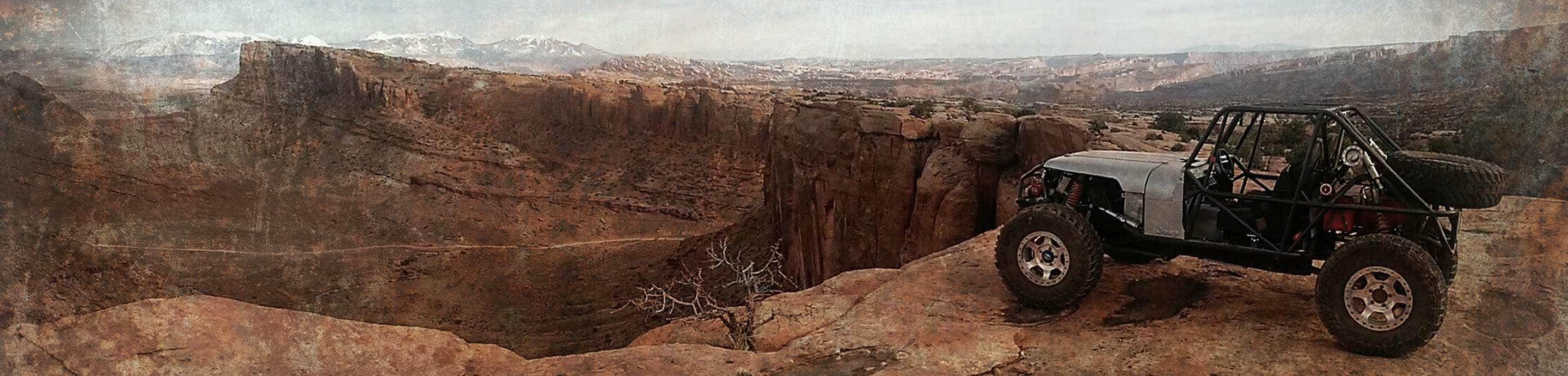


Driveshaft 401 & One-Ton High Angle CV Driveshaft from High Angle Driveline
By BillaVista
![Image]()
![Image]()
Go to --->
Part 1 - Definitions and Operating Descriptions
Part 2 - Driveshaft geometry / How to Choose a Driveshaft
Part 3 - Driveshaft Maintenance
Part 4 - U-joint tech, failure analysis, and driveshaft data
Part 5 - Review - 1350 1Ton CV Driveshaft from High Angle Driveline
Introduction:
In my quest to build my 1-ton rock buggy, The Wolf, as tough as possible, I upgraded my driveline from stock Dana 20 transfer case and hacked-together junkyard 1/2 ton pickup driveshaft to Advance Adapters D20 32 Spline Output and the famous 1 TON 1350 CV driveshaft from Jess at High Angle Driveline.
But before I explain why, how, what else Jess can do, and why High Angle Driveline build the best shafts in the business, I'm going to take you through a little (OK, a LOT!) of driveshaft tech. Why? For 3 reasons:
First, it's important we have a common understanding and language to use, so there is no confusion or misunderstanding (especially in this sport/hobby, where confusion, rumour, legend, and misunderstanding often run rampant - driveshafts being no exception);
Second, because I'm just a super-geek when it comes to accuracy and terminology - you already know this if you've been reading my articles for a while now. Sure, it often get's me beaten up at club event's and four wheeling trips......but the guys really love me, I know they do ;-)
Third, and most importantly, it is because I am committed to bringing my readers only the very best in tech articles and product reviews. I don't do cheesy 2 pic, unwrap, install, "call it good" articles, where I claim the product is superb, even though I clearly know nothing about it. I am committed to providing you with the technical information and facts to make informed decisions, and in so doing, I hope to prove to you that I know a bit about what I'm talking about, and that my opinions, especially on products I recommend, are based on solid knowledge, fact, and experience.
There's a lot to cover, so this article is arranged in 5 broad sections, further subdivided as follows:
Part 1 - Definitions and Operating Descriptions
Part 2 - Driveshaft Geometry
Part 3 - Driveshaft maintenance
Part 4 - U-joint tech, failure analysis
Part 5 - High Angle Driveline 1 ton CV shaft review and testing
Part 1 - Definitions and Operating Descriptions:
There are some very common misconceptions out there about driveshafts, many of which revolve around terminology. To help alleviate this, I offer the following information:
Universal Joints: A universal joint is defined as a "shaft coupling capable of transmitting rotation from one shaft to another not collinear with it." In other words, it is a mechanical device that transmits torque / rotary motion between two shafts that are not in a straight line.
There are 2 types, the:
1) Cardan style universaljoint; and the
2) Constant velocityuniversal joint
We shall explore them both separately:
Cardan Style Universal Joint
![Image]()
The most common type we encounter is the cardan style universal joint, developed by Spicer, and pictured above. This is the familiar "cross and caps" style universal joint, often just referred to as a "U-joint". Remember though, that technically it is a cardan style universal joint.
The way the cardan style universal joint works is as follows (and this is very important to understand):
First - why do we need to use a universal joint in the first place? The answer is easy, and can be surmised from the above definition.
![Image]()
It is because we need to transmit torque from the transfer case to the axle pinion, and of course, the transfer case and pinion are not collinear - they are not in a straight line. The t-case is above the pinion (obviously)! Therefore there is an angle between them. In order to transmit torque or rotation between 2 shafts that are at an angle, we must use a universal joint. In the automotive driveshaft world, 99% of the time that means we use a cardan (cross) style universal joint.
![Image]()
Because of the way the cardan style universal joint operates when the 2 shafts it joins lie at an angle (see pic above - the joint cross or body rotates about it's center, while at the same time the caps rotate around their trunnions), the result is that the joint follows an elliptical, rather than a circular path.
To visualize how this occurs, look down the length of a rear driveshaft at the U-joint in the transfer case yoke. If the pinion end of the driveshaft were unbolted from the differential and lowered to the floor, it would create a severe angle in the forward U-joint. If the shaft were then turned by hand, you'd then be able to see that the two bearing caps on the U-joint center cross attached to the driveshaft rotate in one plane while the two attached to the transfer case yoke rotate in a different plane. All the while the center cross is swiveling back and forth with each revolution.
![Image]()
The best way to illustrate this is to hold 2 shafts coupled by a U-joint in your hand and rotate them- you will quickly see exactly what I mean. The crude drawing to the left may also serve to illustrate what is happening. I have drawn in blue a representation of a second yoke on the other side of the joint from the actual yoke pictured. Now, what happens is, the real yoke and the blue yoke, connected by the U-joint, both rotate around in the direction indicated by the long double-headed arrows. To accommodate the angle between the 2 yokes, the bearing caps each rotate around on their respective trunnions, as indicated by the short double-headed arrow. The result of the combination of these two motions is the U-joint swiveling back and forth each revolution, in a sort of see-saw back-and-forth motion, as indicated by the "V" shaped double-headed arrow. Ultimately, this leads to the elliptical path of the bearing caps, when viewed longitudinally down the shafts.
![Image]()
If you drew what's happening on paper (and of course I have done that for you , the two bearing caps in the transfer case yoke would appear to be traveling in an elliptical (oval) shaped path as viewed down the length of the driveshaft (blue ellipse). Or, from the other point of view, the two bearing caps on the driveshaft would appear to be traveling an elliptical path if viewed from the transfer case (red ellipse). It is this difference in geometry that causes the driven shaft to change speed with respect to the driving shaft.
So, we have two different shafts, connected by a universal joint operating at an angle. Because of this, the ends of the u-joint in each of the yokes in the 2 different shafts (the t-case output yoke, and the yoke at the transfer case end of the driveshaft) both travel in elliptical paths, but the paths are 90° offset (out of phase) from one-another. In the pic above, the blue ellipse represents the path of the input shaft (t-case yoke) and the red ellipse represents the path of the output shaft (driveshaft yoke). Because the 2 shafts are connected to opposite bearing caps, their elliptical paths are offset 90°, as can be seen in the pic.
Now, the problem is, the t-case output is driven from the crankshaft by gears and/or chain drive at a fixed rate (angular velocity) - let's say 1000 rpm for example. Of course, because the driveshaft is mechanically connected to the t-case output, it also must be rotating at 1000 rpm. In the pic, the green arrows show where the two elliptical paths cross, the points of intersection. At these points, the 2 shafts must be in the same place at the same time (otherwise the assembly would come apart.) In order for this to happen, you can see that at times the driveshaft's elliptical path (red ellipse) is longer than the t-case yokes (blue ellipse) and vice versa. So, in order for the assembly to remain together and driven at a fixed rpm, the driveshaft must have to speed up and slow down at different points along it's path in order to match the t-case yoke that is being driven at 1000 rpm. The black arrows show where this happens. In this case, the driveshaft will speed up and slow down a total of 4 times per revolution. That is, it speeds up, slows down, speed up, slows down, then repeats. This is the reason why we say a cardan style universal joint transmits rotation/torque with a "variation in angular velocity between the input and output shafts".
This speeding up and slowing down can cause vibration of the driveshaft and significant wear on the universal joints if not properly accounted for in the driveshafts design. This "accounting for" is what we call driveline geometry and will be discussed in great detail in part 2.
For now, remember that a u-joint must be used because there's an angle between the t-case and pinion (and often a very big angle in the case of lifted 4x4s - which is why this whole driveshaft business is so important to us in the first place). When a u-joint is used, and operates at an angle, the bearing caps on the input and output shafts will describe elliptical paths offset by 90° from one-another because of the difference in geometry between the two opposing bearing caps in the U-joint. Since they travel in elliptical paths, and yet must remain fixed together driven at a constant rpm the driveshaft must therefore speed up and slow down twice each per revolution. This difference in angular velocity between the 2 shafts causes noise, vibration, and u-joint wear, and must be accounted for in proper driveshaft design.
The speed changes are not great when the angle is less than a few degrees, but as the operating angle of the joint increases so do the cyclic vibrations of the driven shaft as well as the back and forth motion in the joint itself.
You can read about the different types of Spicer cardan-style universal joints at spicerdriveshaft.com
Constant-Velocity (CV) Universal Joint:
![Image]()
In marked contrast to the cardan style universal joint, a true constant-velocity (CV) universal joint is one that transmits torque/rotation with an angular velocity ratio of unity between input and output shafts. In other words, even at an angle, the input and output shafts travel at the same (Constant) speed (Velocity) hence the name - Constant Velocity. CV universal joints are not common in 4x4 driveshafts, but are very common in front wheel drive car half-shafts (axles). The pic to above shows a very common style of CV joint, the Rzeppa joint, invented in 1920 by a Dana engineer named Alfred H. Rzeppa.
Their common use in fwd cars is because the joints in the half shafts must accommodate being driven at high speeds for long times as well as changing compound angles due to the front wheels being steered and the front wheels cycling up and down with the suspension. As such, the inner and outer joints in a fwd car half shaft often operate at different angles. Whenever the wheels are turned the outer joint runs at a much higher angle than the inner joint. This upsets the offsetting relationship between inner and outer joint angles that's a necessary requirement for ordinary U-joints. What's more, the front wheels are required to steer at angles of up to 45 degrees-which puts too much strain on a U-joint.
A CV joint, by comparison, always splits the operating angle in half so the driven shaft turns at the exact same speed as the input shaft. So no matter what the joint angle, there are no changes in speed -- thus the name "constant velocity."
Driveshafts: A driveshaft is a device that connects the transfer case to the axles, transmitting torque from the engine to the driving wheels. It is also called a propeller shaft or prop-shaft for short (mostly by Brits and Aussies). Virtually all driveshafts (certainly all that I know of) fit into one of two often misunderstood broad categories. They are:
EITHER
Cardan-style universal joint driveshafts, subdivided into:
![Image]()
Pictured above - double-cardan-style universal joint shaft on top (my new High Angle Driveline shaft) and a single-cardan-style universal joint shaft (the junk I took out!) Note that, as you would expect, the double-cardan shaft has one end (the transfer case end) that has a joint that contains, two cardan-style u-joints - forming the "double-cardan" portion. More on this later.
OR
Constant Velocity (CV) joint style driveshafts.
This is an important distinction, if only academically. You see, true CV joint driveshaft are rare in 4x4 driveshafts (some earlier Jeeps came with GKN CV style front driveshafts that were tiny and weak).
![Image]()
CV joints are, however, extremely common in FWD car half shafts (half axle shafts). Pictured above are some GKN half-shaft CV joints. Virtually all modern cars have them. Virtually all are made by GKN's automotive driveshaft group.
There are many different types of CV joint, including Fixed Ball, Single Roller Tripod Plunging Joint, Ball Plunging Joint, etc. You can read about them at http://www.add.gknplc.com/products.htm None have anything to do with our needs and heavy-duty 4x4 driveshafts.
WHAT???? You cry. But everyone's always talking about CV driveshafts - heck the title of your own article is "1 Ton CV driveshaft" you hypocrite!
You're right - you see, the very common double-cardan-style universal joint shaft (pictured above, upper shaft in pic), is properly called a "near constant velocity, double-cardan-style universal joint shaft." (incidentally, this "velocity" we keep referring to is the angular velocity of the joint in the shaft). Now, what has happened is that because "near constant velocity, double-cardan-style universal joint shaft" is such a huge mouthful, it has become common practice to drop the "near" , "double-cardan-style", and "universal joint" and what we are left with is common convention leading to a double-cardan-style universal joint shaft simply being referred to as a CV shaft.
There - now you know the truth, and you can amaze your friends (or getting soundly beaten by them for being a nerdy smart-ass) at the next trail-side campfire!
So, we know that true CV joint driveshafts are of no interest to us, so forget them now. That leaves us with either single or double cardan style driveshafts. The latter, I shall bow to convention, an henceforth refer to them as CV driveshafts, simply because everyone does.
Now, whether a 4x4s driveshaft is single cardan (also called "regular' or "single-joint" or simply "U-joint) or CV, there is one more distinction to make.
All driveshaft's must have some way of changing length, allowing the driveshaft to shorten or lengthen as required, to accommodate suspension movement. This is because suspension movement will cause the distance between the output of the transfer case and the yoke on the axles pinion to change somewhat. How much the distance changes, and therefore how much "accommodation" you need in your driveshaft will depend on a lot of different factors, including suspension geometry, amount of wheel travel, whether the diff on the axle is centered or offset, etc. For example, a 4 link coil sprung rear axle with center limiting strap will require significantly less length change accommodation than a soft leaf-spring-over-axle front axle with shackle reversal, offset diff, and no limit straps. The former may require only an inch or 2, the latter many inches. The only way to know for sure is to flex the suspension and measure.
The 2 common methods of accommodating this length change, or slip, are:
Type 1 - Slip-yoke shaft. This style is a very common late model rear driveshaft factory style. It comes stock in a great number of 4x4s, including Jeeps, Chevy's, and many others. The slip-yoke is an internally splined tube that slips into the rear output of the transfer case. As the name implies, the slip yoke slips in and out of the transfer case output housing, to accommodate driveshaft length change. generally, this type is not favoured by the hardcore crowd as it's drawbacks generally include:
![Image]()
That said, High Angle Driveline can build you a 1350 1 Ton CV slip-yoke driveshaft. The pic to the left is just such a shaft.
Type 2 - Slip-member shaft. This style is common on trucks and 4x4's, especially older trucks, and is the most desirable type. They use a splined section incorporated in the shaft itself, called the slip-member, which allows the shaft to change length.
![Image]()
The pic above is my new shaft installed, which is a slip-member style shaft. The slip-member is easily visible between the red arrows.
![Image]()
Now that we know all about the different types of shafts, this picture illustrates the names of the various parts of the drive shaft. Where there is more than one common name, the alternate names are shown in brackets.
Driveshaft U-joint Series / Sizes
So we know all about the different types, and all the parts, the last thing we need to know before we can fully and accurately describe and talk about driveshafts is the relative size (and therefore strength), normally determined by and referenced to, the size (series) of the U-joints used in the driveshaft.
A U-joint "series" is a number that describes a group of cardan style universal joints by common dimensional grouping. A series number is not an actual specific part number.
The common U-joint series used in light truck and 4x4 driveshaft construction, with dimensions listed corresponding to the diagram are:
![Image]()
Glossary
So now that we know all the terms and definitions regarding Driveshafts, what else do we need to know to get the best, world class, bulletproof driveshaft under our truck?
Well - the answer is ....depends. It depends on what kind of person you are. If you just want the job done, so you can get behind the wheel, the answer is NOTHING. You simply call up Jess at High Angle Driveline @ (530) 877-2875 and have a nice chat with him about your needs. He will help you with whatever you need, discuss your options with you, and be pleased to talk to you about driveshaft tech, and his customer service is second to none.
However - if you're a tech-geek like me - you want to know more.
Before we get to the actual install of my 1 ton 1350 CV driveshaft, I'll cover the following topics:
Go to --->
Part 1 - Definitions and Operating Descriptions
Part 2 - Driveshaft geometry / How to Choose a Driveshaft
Part 3 - Driveshaft Maintenance
Part 4 - U-joint tech, failure analysis, and driveshaft data
Part 5 - Review - 1350 1Ton CV Driveshaft from High Angle Driveline
Get a GoStats hit counter
By BillaVista
Go to --->
Part 1 - Definitions and Operating Descriptions
Part 2 - Driveshaft geometry / How to Choose a Driveshaft
Part 3 - Driveshaft Maintenance
Part 4 - U-joint tech, failure analysis, and driveshaft data
Part 5 - Review - 1350 1Ton CV Driveshaft from High Angle Driveline
Introduction:
In my quest to build my 1-ton rock buggy, The Wolf, as tough as possible, I upgraded my driveline from stock Dana 20 transfer case and hacked-together junkyard 1/2 ton pickup driveshaft to Advance Adapters D20 32 Spline Output and the famous 1 TON 1350 CV driveshaft from Jess at High Angle Driveline.
But before I explain why, how, what else Jess can do, and why High Angle Driveline build the best shafts in the business, I'm going to take you through a little (OK, a LOT!) of driveshaft tech. Why? For 3 reasons:
First, it's important we have a common understanding and language to use, so there is no confusion or misunderstanding (especially in this sport/hobby, where confusion, rumour, legend, and misunderstanding often run rampant - driveshafts being no exception);
Second, because I'm just a super-geek when it comes to accuracy and terminology - you already know this if you've been reading my articles for a while now. Sure, it often get's me beaten up at club event's and four wheeling trips......but the guys really love me, I know they do ;-)
Third, and most importantly, it is because I am committed to bringing my readers only the very best in tech articles and product reviews. I don't do cheesy 2 pic, unwrap, install, "call it good" articles, where I claim the product is superb, even though I clearly know nothing about it. I am committed to providing you with the technical information and facts to make informed decisions, and in so doing, I hope to prove to you that I know a bit about what I'm talking about, and that my opinions, especially on products I recommend, are based on solid knowledge, fact, and experience.
There's a lot to cover, so this article is arranged in 5 broad sections, further subdivided as follows:
Part 1 - Definitions and Operating Descriptions
- Universal joints
- Driveshafts
- Methods of accommodating length change
- U joint Series
- Glossary
Part 2 - Driveshaft Geometry
- Driveshaft Geometry
- How to choose a driveshaft for your rig
Part 3 - Driveshaft maintenance
- Safety
- Driveshaft Maintenance
Part 4 - U-joint tech, failure analysis
- U-joint Tech
- Driveshaft failure analysis
- Spicer stock driveshaft application information
- Spicer driveshaft component catalogues
- Spicer part number decode information
- Driveshaft / U-joint technical bulletins
- Spicer driveshaft brochures
- Spicer driveshaft division training videos
Part 5 - High Angle Driveline 1 ton CV shaft review and testing
- Product technical details
- Ordering, unwrapping, and installing
- Product Review and critique
- Other products and services
- Contact info
Part 1 - Definitions and Operating Descriptions:
There are some very common misconceptions out there about driveshafts, many of which revolve around terminology. To help alleviate this, I offer the following information:
Universal Joints: A universal joint is defined as a "shaft coupling capable of transmitting rotation from one shaft to another not collinear with it." In other words, it is a mechanical device that transmits torque / rotary motion between two shafts that are not in a straight line.
There are 2 types, the:
1) Cardan style universaljoint; and the
2) Constant velocityuniversal joint
We shall explore them both separately:
Cardan Style Universal Joint
The most common type we encounter is the cardan style universal joint, developed by Spicer, and pictured above. This is the familiar "cross and caps" style universal joint, often just referred to as a "U-joint". Remember though, that technically it is a cardan style universal joint.
The way the cardan style universal joint works is as follows (and this is very important to understand):
First - why do we need to use a universal joint in the first place? The answer is easy, and can be surmised from the above definition.
It is because we need to transmit torque from the transfer case to the axle pinion, and of course, the transfer case and pinion are not collinear - they are not in a straight line. The t-case is above the pinion (obviously)! Therefore there is an angle between them. In order to transmit torque or rotation between 2 shafts that are at an angle, we must use a universal joint. In the automotive driveshaft world, 99% of the time that means we use a cardan (cross) style universal joint.
Because of the way the cardan style universal joint operates when the 2 shafts it joins lie at an angle (see pic above - the joint cross or body rotates about it's center, while at the same time the caps rotate around their trunnions), the result is that the joint follows an elliptical, rather than a circular path.
To visualize how this occurs, look down the length of a rear driveshaft at the U-joint in the transfer case yoke. If the pinion end of the driveshaft were unbolted from the differential and lowered to the floor, it would create a severe angle in the forward U-joint. If the shaft were then turned by hand, you'd then be able to see that the two bearing caps on the U-joint center cross attached to the driveshaft rotate in one plane while the two attached to the transfer case yoke rotate in a different plane. All the while the center cross is swiveling back and forth with each revolution.
The best way to illustrate this is to hold 2 shafts coupled by a U-joint in your hand and rotate them- you will quickly see exactly what I mean. The crude drawing to the left may also serve to illustrate what is happening. I have drawn in blue a representation of a second yoke on the other side of the joint from the actual yoke pictured. Now, what happens is, the real yoke and the blue yoke, connected by the U-joint, both rotate around in the direction indicated by the long double-headed arrows. To accommodate the angle between the 2 yokes, the bearing caps each rotate around on their respective trunnions, as indicated by the short double-headed arrow. The result of the combination of these two motions is the U-joint swiveling back and forth each revolution, in a sort of see-saw back-and-forth motion, as indicated by the "V" shaped double-headed arrow. Ultimately, this leads to the elliptical path of the bearing caps, when viewed longitudinally down the shafts.
If you drew what's happening on paper (and of course I have done that for you
, the two bearing caps in the transfer case yoke would appear to be traveling in an elliptical (oval) shaped path as viewed down the length of the driveshaft (blue ellipse). Or, from the other point of view, the two bearing caps on the driveshaft would appear to be traveling an elliptical path if viewed from the transfer case (red ellipse). It is this difference in geometry that causes the driven shaft to change speed with respect to the driving shaft. So, we have two different shafts, connected by a universal joint operating at an angle. Because of this, the ends of the u-joint in each of the yokes in the 2 different shafts (the t-case output yoke, and the yoke at the transfer case end of the driveshaft) both travel in elliptical paths, but the paths are 90° offset (out of phase) from one-another. In the pic above, the blue ellipse represents the path of the input shaft (t-case yoke) and the red ellipse represents the path of the output shaft (driveshaft yoke). Because the 2 shafts are connected to opposite bearing caps, their elliptical paths are offset 90°, as can be seen in the pic.
Now, the problem is, the t-case output is driven from the crankshaft by gears and/or chain drive at a fixed rate (angular velocity) - let's say 1000 rpm for example. Of course, because the driveshaft is mechanically connected to the t-case output, it also must be rotating at 1000 rpm. In the pic, the green arrows show where the two elliptical paths cross, the points of intersection. At these points, the 2 shafts must be in the same place at the same time (otherwise the assembly would come apart.) In order for this to happen, you can see that at times the driveshaft's elliptical path (red ellipse) is longer than the t-case yokes (blue ellipse) and vice versa. So, in order for the assembly to remain together and driven at a fixed rpm, the driveshaft must have to speed up and slow down at different points along it's path in order to match the t-case yoke that is being driven at 1000 rpm. The black arrows show where this happens. In this case, the driveshaft will speed up and slow down a total of 4 times per revolution. That is, it speeds up, slows down, speed up, slows down, then repeats. This is the reason why we say a cardan style universal joint transmits rotation/torque with a "variation in angular velocity between the input and output shafts".
This speeding up and slowing down can cause vibration of the driveshaft and significant wear on the universal joints if not properly accounted for in the driveshafts design. This "accounting for" is what we call driveline geometry and will be discussed in great detail in part 2.
For now, remember that a u-joint must be used because there's an angle between the t-case and pinion (and often a very big angle in the case of lifted 4x4s - which is why this whole driveshaft business is so important to us in the first place). When a u-joint is used, and operates at an angle, the bearing caps on the input and output shafts will describe elliptical paths offset by 90° from one-another because of the difference in geometry between the two opposing bearing caps in the U-joint. Since they travel in elliptical paths, and yet must remain fixed together driven at a constant rpm the driveshaft must therefore speed up and slow down twice each per revolution. This difference in angular velocity between the 2 shafts causes noise, vibration, and u-joint wear, and must be accounted for in proper driveshaft design.
The speed changes are not great when the angle is less than a few degrees, but as the operating angle of the joint increases so do the cyclic vibrations of the driven shaft as well as the back and forth motion in the joint itself.
You can read about the different types of Spicer cardan-style universal joints at spicerdriveshaft.com
Constant-Velocity (CV) Universal Joint:
In marked contrast to the cardan style universal joint, a true constant-velocity (CV) universal joint is one that transmits torque/rotation with an angular velocity ratio of unity between input and output shafts. In other words, even at an angle, the input and output shafts travel at the same (Constant) speed (Velocity) hence the name - Constant Velocity. CV universal joints are not common in 4x4 driveshafts, but are very common in front wheel drive car half-shafts (axles). The pic to above shows a very common style of CV joint, the Rzeppa joint, invented in 1920 by a Dana engineer named Alfred H. Rzeppa.
Their common use in fwd cars is because the joints in the half shafts must accommodate being driven at high speeds for long times as well as changing compound angles due to the front wheels being steered and the front wheels cycling up and down with the suspension. As such, the inner and outer joints in a fwd car half shaft often operate at different angles. Whenever the wheels are turned the outer joint runs at a much higher angle than the inner joint. This upsets the offsetting relationship between inner and outer joint angles that's a necessary requirement for ordinary U-joints. What's more, the front wheels are required to steer at angles of up to 45 degrees-which puts too much strain on a U-joint.
A CV joint, by comparison, always splits the operating angle in half so the driven shaft turns at the exact same speed as the input shaft. So no matter what the joint angle, there are no changes in speed -- thus the name "constant velocity."
Driveshafts: A driveshaft is a device that connects the transfer case to the axles, transmitting torque from the engine to the driving wheels. It is also called a propeller shaft or prop-shaft for short (mostly by Brits and Aussies). Virtually all driveshafts (certainly all that I know of) fit into one of two often misunderstood broad categories. They are:
EITHER
Cardan-style universal joint driveshafts, subdivided into:
- Single-Cardan-style universal joint shaft; or
- Double-Cardan-style universal joint shaft
Pictured above - double-cardan-style universal joint shaft on top (my new High Angle Driveline shaft) and a single-cardan-style universal joint shaft (the junk I took out!) Note that, as you would expect, the double-cardan shaft has one end (the transfer case end) that has a joint that contains, two cardan-style u-joints - forming the "double-cardan" portion. More on this later.
OR
Constant Velocity (CV) joint style driveshafts.
This is an important distinction, if only academically. You see, true CV joint driveshaft are rare in 4x4 driveshafts (some earlier Jeeps came with GKN CV style front driveshafts that were tiny and weak).
CV joints are, however, extremely common in FWD car half shafts (half axle shafts). Pictured above are some GKN half-shaft CV joints. Virtually all modern cars have them. Virtually all are made by GKN's automotive driveshaft group.
There are many different types of CV joint, including Fixed Ball, Single Roller Tripod Plunging Joint, Ball Plunging Joint, etc. You can read about them at http://www.add.gknplc.com/products.htm None have anything to do with our needs and heavy-duty 4x4 driveshafts.
WHAT???? You cry. But everyone's always talking about CV driveshafts - heck the title of your own article is "1 Ton CV driveshaft" you hypocrite!
You're right - you see, the very common double-cardan-style universal joint shaft (pictured above, upper shaft in pic), is properly called a "near constant velocity, double-cardan-style universal joint shaft." (incidentally, this "velocity" we keep referring to is the angular velocity of the joint in the shaft). Now, what has happened is that because "near constant velocity, double-cardan-style universal joint shaft" is such a huge mouthful, it has become common practice to drop the "near" , "double-cardan-style", and "universal joint" and what we are left with is common convention leading to a double-cardan-style universal joint shaft simply being referred to as a CV shaft.
There - now you know the truth, and you can amaze your friends (or getting soundly beaten by them for being a nerdy smart-ass) at the next trail-side campfire!
So, we know that true CV joint driveshafts are of no interest to us, so forget them now. That leaves us with either single or double cardan style driveshafts. The latter, I shall bow to convention, an henceforth refer to them as CV driveshafts, simply because everyone does.
Now, whether a 4x4s driveshaft is single cardan (also called "regular' or "single-joint" or simply "U-joint) or CV, there is one more distinction to make.
All driveshaft's must have some way of changing length, allowing the driveshaft to shorten or lengthen as required, to accommodate suspension movement. This is because suspension movement will cause the distance between the output of the transfer case and the yoke on the axles pinion to change somewhat. How much the distance changes, and therefore how much "accommodation" you need in your driveshaft will depend on a lot of different factors, including suspension geometry, amount of wheel travel, whether the diff on the axle is centered or offset, etc. For example, a 4 link coil sprung rear axle with center limiting strap will require significantly less length change accommodation than a soft leaf-spring-over-axle front axle with shackle reversal, offset diff, and no limit straps. The former may require only an inch or 2, the latter many inches. The only way to know for sure is to flex the suspension and measure.
The 2 common methods of accommodating this length change, or slip, are:
Type 1 - Slip-yoke shaft. This style is a very common late model rear driveshaft factory style. It comes stock in a great number of 4x4s, including Jeeps, Chevy's, and many others. The slip-yoke is an internally splined tube that slips into the rear output of the transfer case. As the name implies, the slip yoke slips in and out of the transfer case output housing, to accommodate driveshaft length change. generally, this type is not favoured by the hardcore crowd as it's drawbacks generally include:
- Small u-joint size (stock)
- Small tubing (stock)
- Limited travel in the slip yoke
- The fact that the transfer case output is sealed by the slip yoke, meaning that if you break a u-joint or the shaft, and have to remove the slip yoke, you have to have some sort of method for plugging the transfer case output hole, otherwise the t-case will lose all its fluid.
That said, High Angle Driveline can build you a 1350 1 Ton CV slip-yoke driveshaft. The pic to the left is just such a shaft.
Type 2 - Slip-member shaft. This style is common on trucks and 4x4's, especially older trucks, and is the most desirable type. They use a splined section incorporated in the shaft itself, called the slip-member, which allows the shaft to change length.
The pic above is my new shaft installed, which is a slip-member style shaft. The slip-member is easily visible between the red arrows.
Now that we know all about the different types of shafts, this picture illustrates the names of the various parts of the drive shaft. Where there is more than one common name, the alternate names are shown in brackets.
Driveshaft U-joint Series / Sizes
So we know all about the different types, and all the parts, the last thing we need to know before we can fully and accurately describe and talk about driveshafts is the relative size (and therefore strength), normally determined by and referenced to, the size (series) of the U-joints used in the driveshaft.
A U-joint "series" is a number that describes a group of cardan style universal joints by common dimensional grouping. A series number is not an actual specific part number.
The common U-joint series used in light truck and 4x4 driveshaft construction, with dimensions listed corresponding to the diagram are:
| U-joint series | Joint width (W) (inches) | Cap diameter (D) (inches) | Maximum Angle | Continuous rating (lb-ft) | Short Duration rating (lb-ft) |
| 1310 | 3.219 | 1.062 | 30 | 130 | 800 |
| 1330 | 3.625 | 1.062 | 20 | 150 | 890 |
| 1350 | 3.625 | 1.188 | 20 | 210 | 1240 |
| 1410 | 4.188 | 1.188 | 37 | 250 | 1500 |
Glossary
- Bearing Cup Assembly - Consists of a bearing cup with needle rollers generally held in place by a seal guard and bearing seal. Sometimes the assembly includes a thrust washer.
- Bearing Cup - A cup-shaped member used as the bearing bore of a bearing cup assembly and for positioning a thrust end of a cross trunnion.
- Bearing Seal - A flexible member of a bearing cup assembly which prevents the escape of lubricant from or entry of foreign matter into a bearing.
- Boot - A flexible member which prevents the escape of lubricant from or entry of foreign matter into the slip member assembly.
- Boot Clamp - A thin adjustable band used to hold the boot in position on the slip member assembly.
- Boot Seal - See Boot.
- Companion Flange - A fixed flange member that attaches a steering shaft (intermediate shaft) to a steering gear box or steering column shaft.
- Cross - See Journal Cross.
- Cross Hole - A through hole in each lug ear of a yoke used to locate a bearing cup assembly.
- Ear- One of two projecting parts of a yoke symmetrically located with respect to the yoke's rotational axis.
- End Fitting - An end yoke or companion flange that attaches a driveshaft to a transfer case or axle (pinion).
- End Yoke - A yoke that attaches a driveshaft to a transfer case or axle (pinion).
- Flange Yoke - A full-round style yoke which attaches a driveshaft to a transfer case or axle (pinion).
- Glidecote® - The blue, nylon, wear-resistant coating on Spicer yoke shafts.
- Grease Zerk (Nipple) Fitting- The fitting on the shoulder or center of a journal cross that allows for lubrication.
- Inboard Yokes - Yokes that make up the ends of a driveshaft.
- Intermediate Shaft - See Steering Shaft.
- Journal Cross - The core component of a universal joint which is an intermediate drive member with four equally spaced trunnions in the same plane.
- Lug Ear - See Ear.
- Needle Roller Bearings - See Needle Rollers.
- Needle Rollers - One of the rolling elements of a bearing cup assembly.
- Outboard Yokes - Yokes that are not a part of a driveshaft (i.e. yokes that are part of a transfer case output or axle (pinion) input.
- Phasing - The relative rotational position of each yoke on a driveshaft.
- Pinch Bolt - Bolt used to compress slotted end fittings for retention.
- Purge- The act of flushing old grease and contaminants from universal joint kits with fresh grease.
- Slip Member Assembly - Combination of slip spline, slip yoke and boot assembly.
- Slip Spline- A patented tubular-type, machined element consisting of internal splines in a driveshaft assembly.
- Slip Yoke - A slip member yoke with a female machined spline used for axial movement.
- Slip Yoke Plug - See Welch Plug.
- Snap Ring - A removable member used as a shoulder to retain and position a bearing cup assembly in a yoke cross hole.
- Snap Ring Groove- A groove used to locate a snap ring.
- Spline - A machined element consisting of integral keys (splined teeth) or keyways (spaces) equally spaced around a circle or portion thereof.
- Trunnion(s)- Any of the four projecting journals of a cross.
- Universal Joint - A mechanical device which can transmit torque and/or rotary motion from one shaft to another at fixed or varying angles of intersection of the shaft axes. Consisting usually of a journal cross, grease zerk (nipple) fitting and four bearing cup assemblies.
- Universal Joint Kit - See Universal Joint.
- U-Joint - See Universal Joint.
- Welch Plug- A plug in the slip yoke face that seals off one end of the spline opening. Also known as a slip yoke plug.
- Yoke Lug Ear Cross Hole - See Cross Hole.
- Yoke Shaft - A slip member yoke with a male machined spline used for axial movement.
So now that we know all the terms and definitions regarding Driveshafts, what else do we need to know to get the best, world class, bulletproof driveshaft under our truck?
Well - the answer is ....depends. It depends on what kind of person you are. If you just want the job done, so you can get behind the wheel, the answer is NOTHING. You simply call up Jess at High Angle Driveline @ (530) 877-2875 and have a nice chat with him about your needs. He will help you with whatever you need, discuss your options with you, and be pleased to talk to you about driveshaft tech, and his customer service is second to none.
However - if you're a tech-geek like me - you want to know more.
Before we get to the actual install of my 1 ton 1350 CV driveshaft, I'll cover the following topics:
- Part 2
- Driveshaft Geometry
- How to choose a driveshaft for your rig
- Part 3
- Driveshaft Maintenance
- safety, inspection, lubrication
- removal, replacement, installation
- Driveshaft Maintenance
- Part 4
- U-joint Tech
- Causes and analysis of driveshaft failure
- Spicer stock driveshaft application information
- Spicer driveshaft component catalogue
- Spicer part number decode information
- Driveshaft / U-joint technical bulletins
- Spicer driveshaft brochures
- Spicer driveshaft division training videos
Go to --->
Part 1 - Definitions and Operating Descriptions
Part 2 - Driveshaft geometry / How to Choose a Driveshaft
Part 3 - Driveshaft Maintenance
Part 4 - U-joint tech, failure analysis, and driveshaft data
Part 5 - Review - 1350 1Ton CV Driveshaft from High Angle Driveline
Get a GoStats hit counter